
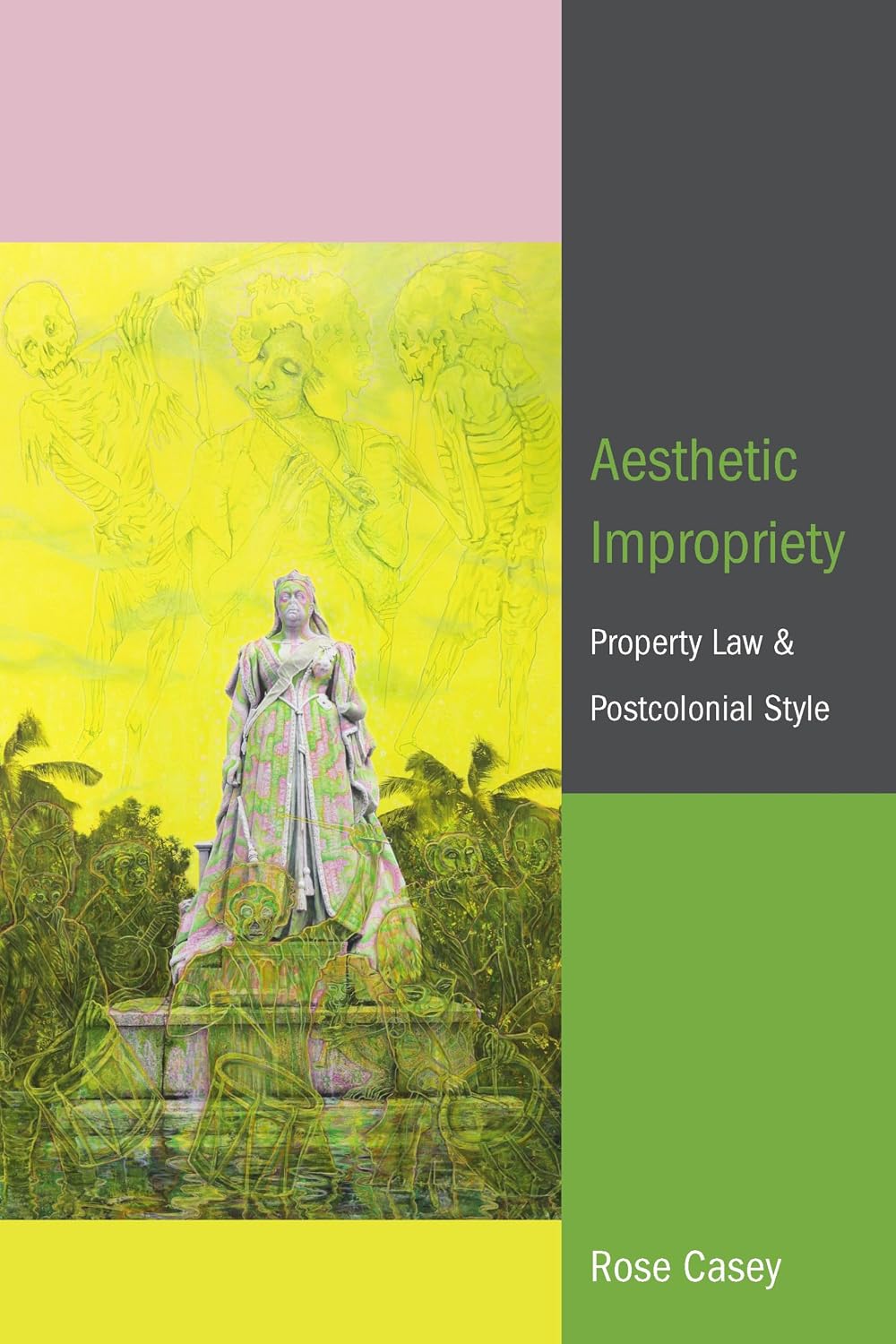
Aesthetic Impropriety: Property Law and Postcolonial Style
Product details
| Management number | 233574507 | Release Date | 2026/06/27 | List Price | US$9.45 | Model Number | 233574507 | ||
|---|---|---|---|---|---|---|---|---|---|
| Category | |||||||||
Across Africa, Asia, and the Americas, colonial Britain’s property laws are in the process of being transformed. Aesthetic Impropriety analyzes vanguard legal actions and literary innovations to reveal contemporary reforms to property law that are undoing law’s colonial legacies. Casey traces precise legal histories across distinct jurisdictions throughout the anglophone world, revealing the connection between land law and petroleum extraction in the Niger Delta, inheritance and divorce laws and gender inequality in India, intellectual property law and Indigenous dispossession in South Africa, and admiralty law and racialized non-personhood in the English Atlantic. In response to these manifold forms of dispossession, significant reforms are underway, including through common law suits, statutory reform, and proposed changes to legal doctrine. Casey develops the concept of aesthetic impropriety to identify shared structures of thought across legal and literary venues. She shows that writers of poetry and prose are also transforming harmful property laws: in Nigeria, Ben Okri and Chigozie Obioma have articulated symbiotic ecological relationships that are also evidenced in recent actions against petroleum companies; in India, Arundhati Roy’s challenge to divorce laws has preempted similar attempts at reform in Parliament; in South Africa, Zoë Wicomb theorized protections for Indigenous modes of creative production nineteen years before they were signed into law; and in the Americas, M. NourbeSe Philip has proposed a novel method of achieving justice for the one hundred fifty enslaved people who were killed in the 1781 Zong massacre. Aesthetic Impropriety makes a convincing case for literature’s generative capacities and registers the enduring significance of the postcolonial as a necessary framework for understanding globalized inequality in the twenty-first century. By analyzing shared legal and aesthetic transformations, Aesthetic Impropriety argues that law and literature play vital roles in creating anticolonial world orders. Read more
| ISBN10 | 1531510639 |
|---|---|
| ISBN13 | 978-1531510633 |
| Edition | 1st |
| Language | English |
| Publisher | Fordham University Press |
| Dimensions | 6 x 1.18 x 9 inches |
| Item Weight | 12 ounces |
| Print length | 208 pages |
| Publication date | July 1, 2025 |
Bestseller ranking
Indian






Customers who viewed this product also viewed
African



Correction of product information
If you notice any omissions or errors in the product information on this page, please use the correction request form below.
Correction Request Form